
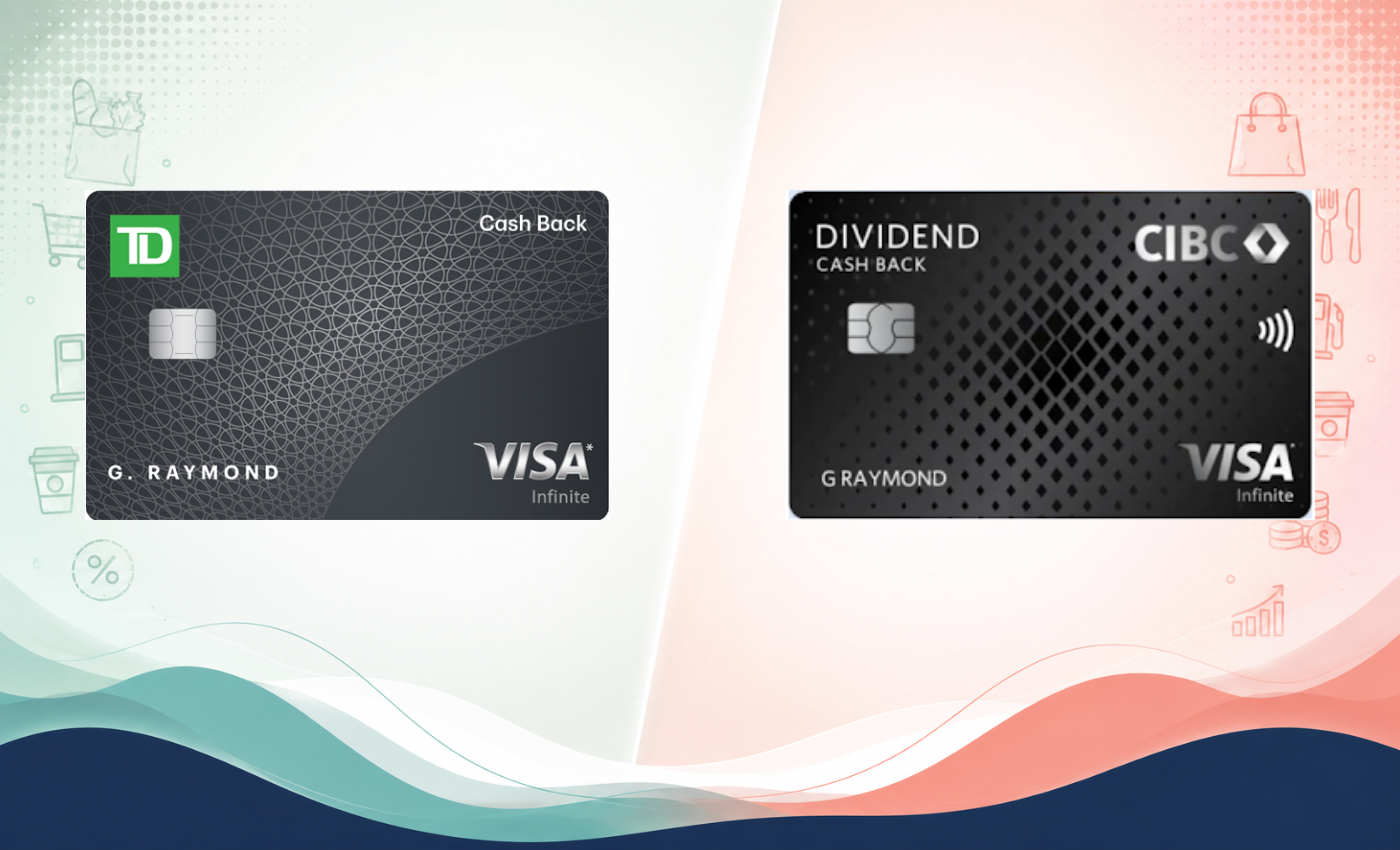
TD Cash Back vs CIBC Dividend — last verified: August 2026. Credit card rates, fees, and welcome offers change often, so treat specific numbers as a snapshot and always confirm current details directly with the bank before applying.
If you’ve narrowed your search for a cashback credit card down to these two, you’ve picked two of the most popular mid-tier cashback cards in Canada. Both charge a similar annual fee and reward everyday spending — but the details matter more than they first appear.
Short answer: The CIBC Dividend Visa Infinite pays a higher top rate (4% versus 3%) but only on groceries and gas, while the TD Cash Back Visa Infinite spreads 3% across more categories, including bills and streaming, and currently has the larger welcome offer. CIBC’s enhanced rates stop after $20,000 in combined bonus-category spending each year, a detail its marketing does not emphasize. In a typical household example CIBC came out slightly ahead.Key points from this guide · last reviewed Sep 11, 2026
The Quick Comparison
| TD Cash Back Visa Infinite | CIBC Dividend Visa Infinite | |
|---|---|---|
| Annual fee | $139 (first year rebated) | $120 (first year rebated) |
| Top cash back rate | 3% | 4% |
| Categories at top rate | Groceries, gas & EV charging, public transit, recurring bills, streaming/digital gaming | Groceries, gas & EV charging |
| Second-tier rate | — (flat 3% or 1%) | 2% on dining, transportation, recurring payments |
| Everything else | 1% | 1% |
| Annual cap on bonus rates | $15,000 per category (independent caps) | $20,000 combined across bonus categories, or $50,000 in total card spending — whichever comes first |
| Minimum income | $60,000 individual / $100,000 household | $60,000 individual / $100,000 household |
| Welcome offer (current) | Up to $600 total value | Up to $350 total value |
| Foreign transaction fee | 2.5% | 2.5% |
In simple terms: CIBC pays a higher rate on groceries and gas specifically, while TD spreads a slightly lower rate across a wider list of everyday categories, including bills and streaming.
TD Cash Back Visa Infinite: The Details
- Annual fee: $139 for the primary cardholder, $50 for a secondary cardholder (rebated in year one).
- 3% cash back on groceries, gas and EV charging, public transit, recurring bill payments, and streaming/digital gaming/media — up to $15,000 in spending per category, per year.
- 1% cash back on everything else.
- Welcome offer: up to $600 in total value — 10% cash back (up to $350) on eligible bonus-category spending up to $3,500 in your first 3 months, plus the first-year annual fee rebate ($189 combined for the primary and one additional card) and a complimentary TD Auto Club roadside assistance membership.
- Extras: travel emergency medical coverage (10 days), rental car collision/loss damage insurance, mobile device insurance, purchase security and extended warranty.
Watch out for: the travel insurance doesn’t include trip cancellation, trip interruption, or flight delay coverage — worth knowing if you were expecting a fuller travel insurance package from a card at this fee level.
CIBC Dividend Visa Infinite: The Details
- Annual fee: $120 for the primary cardholder, $50 per additional cardholder (rebated in year one) — and it can be waived entirely if you hold a CIBC Smart Plus bank account.
- 4% cash back on groceries, gas, and EV charging.
- 2% cash back on dining, transportation, recurring payments, and travel booked through CIBC’s Expedia partnership.
- 1% cash back on everything else, with no limit on total cash back earned overall.
- The 4% and 2% enhanced rates apply to the first $20,000 in combined annual spending across those bonus categories — or the first $50,000 in total card purchases across any merchant, whichever threshold you hit first. After that, everything drops to 1% until your December statement date resets the count.
- Welcome offer: a 10% cash back bonus (up to $200) on your first $2,000 in spending over your first 4 statements, plus a $50 bonus for setting up one pre-authorized payment, plus the first-year fee rebate — up to $350 in total value.
- Extras: emergency travel medical coverage, common carrier accident insurance, rental car insurance, mobile device insurance, and purchase security/extended warranty.
Watch out for: the $350 welcome offer looks smaller than TD’s on paper, and like TD, the travel insurance package is relatively basic. Also double-check the $20,000 bonus-category cap if you’re a high spender — it’s lower than it might sound, especially if groceries and gas make up most of your monthly budget.
TD Cash Back vs CIBC Dividend: A Simple Real-World Example
Numbers make this easier to picture. Say someone spends:
- $6,000/year on groceries and gas combined
- $2,400/year on dining, transit, and recurring bills combined
- $12,000/year on everything else
With TD Cash Back Visa Infinite:
$8,400 at 3% (groceries, gas, transit, bills) = $252, plus $12,000 at 1% = $120. Total: $372 — minus the $139 annual fee (after year one) = $233 net.
With CIBC Dividend Visa Infinite:
$6,000 at 4% (groceries, gas) = $240, plus $2,400 at 2% (dining, transportation, recurring) = $48, plus $12,000 at 1% = $120. Total: $408 — minus the $120 annual fee (after year one) = $288 net. (This spender’s $8,400 in bonus-category spending stays well under CIBC’s $20,000 cap, so the full enhanced rate applies all year.)
What this means for you: in this example, CIBC comes out ahead — mainly because its 4% grocery/gas rate is a full point higher than TD’s 3%, and its annual fee is lower. But this is just one spending pattern. If you spend heavily on streaming or digital subscriptions specifically (which TD rewards at 3% and CIBC doesn’t call out at all), or if your grocery and gas spending regularly tops $20,000 a year, the math can shift back toward TD.
Quick Tip: pull up your last 2–3 months of statements and roughly total your spending by category before deciding — your own numbers matter far more than any generic example.
TD Cash Back vs CIBC Dividend: Which Card Should You Choose?
- Choose CIBC Dividend Visa Infinite if: groceries and gas make up a large share of your spending (but typically under $20,000/year), you want a lower annual fee, or you already bank with CIBC and can get the fee waived through a Smart Plus account.
- Choose TD Cash Back Visa Infinite if: your spending is more spread out across categories like public transit, streaming, and recurring bills — or you’re a heavier spender who’d bump into CIBC’s $20,000 bonus-category cap.
- Either way: both require the same minimum income ($60,000 individual / $100,000 household), so approval odds on that front are similar.
Key Takeaways
- CIBC Dividend Visa Infinite offers a higher top cash back rate (4% vs. 3%) but on a narrower set of categories (groceries and gas only).
- TD Cash Back Visa Infinite spreads its 3% rate across more categories, including bills and streaming, with each category capped independently at $15,000/year, and currently has a larger welcome offer.
- CIBC’s enhanced rates stop after $20,000 in combined bonus-category spending (or $50,000 in total card spending) each year — a detail that’s easy to miss since CIBC’s own marketing emphasizes “no limit on total cash back.”
- In a typical household spending example, CIBC came out slightly ahead — but your own spending mix, and whether you’d hit CIBC’s cap, could easily tip it the other way.
- Both cards require similar income to qualify and charge a similar 2.5% foreign transaction fee.
- Neither card’s travel insurance includes trip cancellation or flight delay coverage — factor that in if travel protection matters to you.
The Bottom Line: these two cards are closer than they first appear. The right choice comes down to where your money actually goes each month — run your own numbers rather than assuming the card with the flashier percentage automatically wins.
Frequently Asked Questions About TD Cash Back vs CIBC Dividend
Which card has the higher cash back rate: TD Cash Back or CIBC Dividend? CIBC Dividend Visa Infinite has the higher top rate at 4% on groceries and gas, compared to TD’s 3% across a wider set of categories. But CIBC’s enhanced rate stops after $20,000 in combined bonus-category spending each year, while TD caps each category independently at $15,000.
Is there an annual spending limit on CIBC Dividend Visa Infinite’s cash back? Yes — the 4% and 2% enhanced rates apply to the first $20,000 in combined annual spending across bonus categories (or $50,000 in total card purchases, whichever comes first). After that, everything earns the base 1% rate until the cap resets on your December statement.
Can I get the CIBC Dividend Visa Infinite annual fee waived? Yes — the $120 annual fee can be waived if you hold an eligible CIBC Smart Plus bank account, on top of the standard first-year fee rebate available to new cardholders.
Which card has the better welcome offer: TD Cash Back or CIBC Dividend? TD’s current welcome offer is worth more on paper — up to $600 in total value, compared to CIBC’s up to $350. But a welcome offer is a one-time bonus; your ongoing cash back rate on your actual spending matters more over the long run.
Want to keep learning? Browse more beginner-friendly personal finance guides on MoneyMint, including our guide to what a TFSA is.
This article is for general educational purposes and isn’t financial advice. Credit card terms, rates, and welcome offers change frequently and can vary by province — always confirm current details directly with TD or CIBC before applying.