
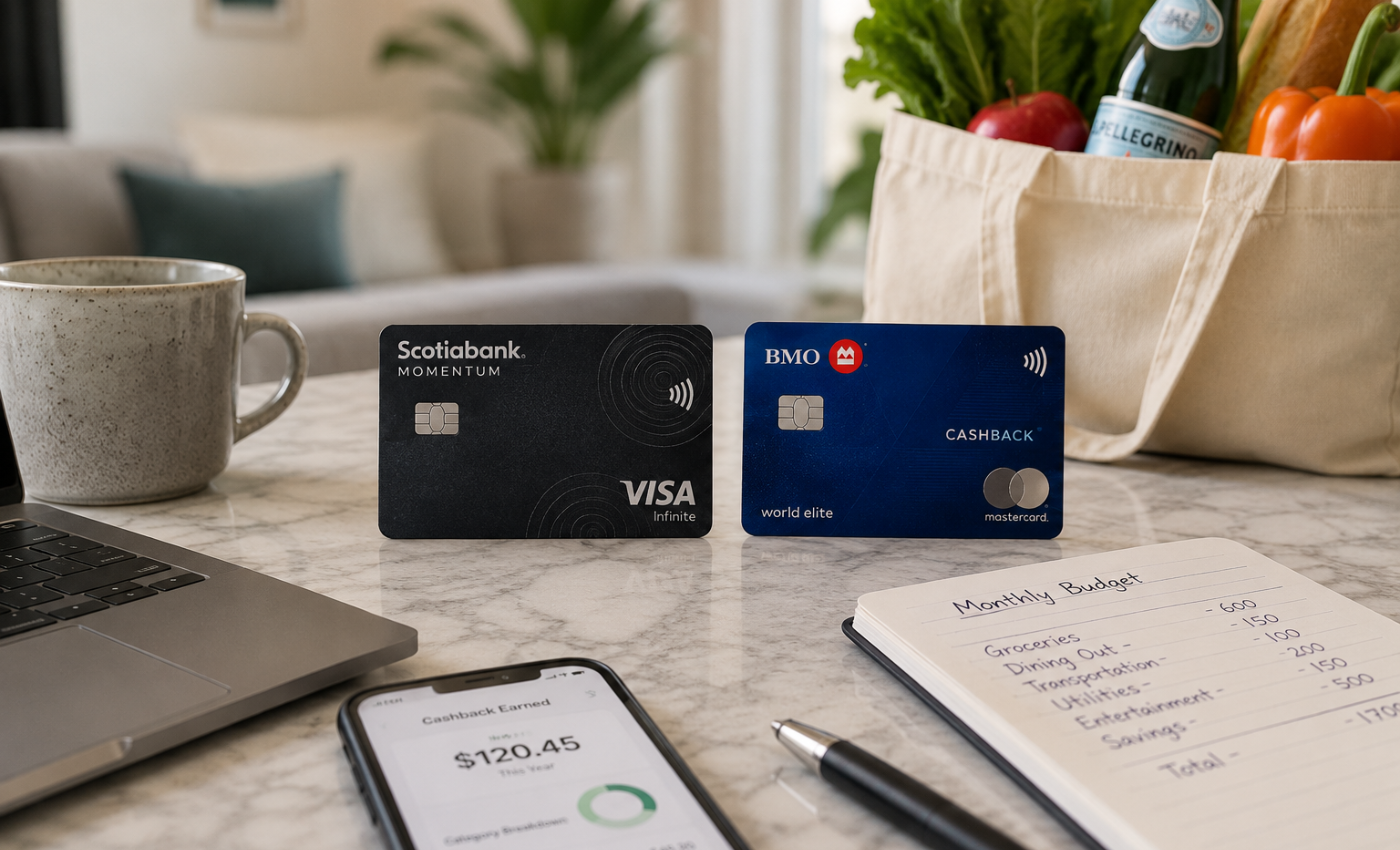
Scotia Momentum vs BMO CashBack — last verified: August 2026. Credit card fees, cash back rates, and welcome offers change often, so treat specific numbers as a snapshot and always confirm current details directly with the issuer before applying.
On paper, BMO’s card looks like the clear winner — its top cash back rate is a full percentage point higher than Scotiabank®’s. But the fine print tells a different story, and which card actually pays you more depends heavily on how you spend, not just how much.
Short answer: The BMO CashBack World Elite offers higher percentage rates, but tight monthly spending caps limit how much you can earn at those rates, while the Scotia Momentum Visa Infinite pays slightly lower rates with far more generous annual caps. In a moderate, evenly spread spending example BMO edged ahead, but bigger single-category spending flips the advantage to Scotiabank, and BMO requires a notably higher income to qualify.Key points from this guide · last reviewed Sep 11, 2026
Scotia Momentum vs BMO CashBack: The Quick Comparison
| Scotia Momentum® Visa Infinite +* Card | BMO CashBack World Elite | |
|---|---|---|
| Annual fee | $120 (waived first year) | $139 (waived first year) |
| Top cash back rate | 4% (groceries & recurring bills) | 5% (groceries) |
| Other elevated rates | 2% gas, EV charging, transit, rideshare, food delivery | 4% transit, 3% gas & EV, 2% recurring bills |
| Everything else | 1% | 1% |
| How the caps work | Up to $25,000/year per category | Up to $500/month (groceries, bills) or $300/month (transit, gas) |
| Minimum income | $60,000 individual / $100,000 household | $80,000 individual / $150,000 household |
| Welcome offer | About $420 total value | Up to $650 total value |
| Foreign transaction fee | 2.5% | 2.5% |
In simple terms: BMO pays a higher percentage, but on a much smaller amount of monthly spending before the rate drops. Scotiabank pays a bit less per dollar, but on a much larger yearly amount before that happens.
Scotia Momentum Visa Infinite: The Details
- Fee: $120, waived for the first year under the current offer.
- 4% cash back on groceries and recurring bill payments — up to $25,000 in spending per year, per category.
- 2% cash back on gas, EV charging, transit, rideshare, and food delivery — also up to $25,000/year.
- 1% cash back on everything else, and on spending beyond the category caps.
- Welcome offer: 15% cash back on your first $2,000 in purchases over 3 months (up to $300), plus the first-year fee waiver — about $420 in total value.
- Minimum income: $60,000 individual or $100,000 household.
Good to know: those $25,000-per-year caps are generous — most everyday spenders will never come close to hitting them, meaning the 4%/2% rates effectively apply to nearly all your qualifying spending, all year.
BMO CashBack World Elite: The Details
- Fee: $139 for the primary cardholder (waived first year), $50 for a secondary cardholder.
- 5% cash back on groceries — but only up to $500 in spending per month.
- 4% cash back on transit, up to $300/month.
- 3% cash back on gas and EV charging, up to $300/month.
- 2% cash back on recurring bill payments, up to $500/month.
- 1% cash back on everything else, with no cap.
- Welcome offer: up to $650 in total value, including $40 in monthly cash back bonuses for hitting $2,000 in spending each billing cycle during year one, plus the first-year fee rebate.
- Minimum income: $80,000 individual or $150,000 household — notably higher than most competing cashback cards.
Good to know: those monthly caps are tight. Spend more than $500 on groceries in a single month, and everything past that drops straight to the base 1% rate until the next month resets.
Scotia Momentum vs BMO CashBack: A Simple Real-World Example
Let’s say someone spends $500/month on groceries, $150/month on gas, $100/month on transit, $150/month on recurring bills, and $600/month on everything else — pretty typical, moderate spending that stays under BMO’s monthly caps.
Scotia Momentum: groceries + bills ($7,800/year) at 4% = $312. Gas + transit ($3,000/year) at 2% = $60. Everything else ($7,200/year) at 1% = $72. Total: about $444, minus the $120 fee (after year one) = about $324 net.
BMO CashBack World Elite: groceries ($6,000/year, exactly at the monthly cap) at 5% = $300. Bills ($1,800) at 2% = $36. Transit ($1,200) at 4% = $48. Gas ($1,800) at 3% = $54. Everything else ($7,200) at 1% = $72. Total: about $510, minus the $139 fee (after year one) = about $371 net.
In this scenario, BMO wins — but only because spending stayed under its monthly caps.
Now change one thing: if that same person spent $800/month on groceries instead of $500, BMO’s 5% rate would only apply to the first $500 each month — the extra $300/month would earn just 1%. Scotiabank’s much higher annual cap means the full amount would still earn 4%. At that spending level, Scotiabank pulls ahead on groceries alone.
What this means for you: BMO rewards moderate, spread-out spending that stays under its monthly ceilings. Scotiabank rewards bigger, more concentrated spending in its bonus categories, since its cap is yearly and much higher.
Quick Tip: if your grocery or bill spending regularly spikes in any single month — a big holiday shop, a large bill — check whether that spending would blow past BMO’s monthly cap before assuming its higher percentage automatically wins.
Scotia Momentum vs BMO CashBack: Which Card Should You Choose?
- Choose BMO CashBack World Elite if: your monthly spending in each bonus category consistently stays under the caps ($500 for groceries/bills, $300 for transit/gas), and you meet the higher income requirement.
- Choose Scotia Momentum Visa Infinite if: you have big or unpredictable spending months in groceries or bills, prefer a lower income requirement, or want to avoid tracking monthly caps altogether.
- Keep in mind: BMO’s income requirement ($80,000/$150,000) is meaningfully higher than Scotiabank’s ($60,000/$100,000) — for some readers, that alone will decide the matchup.
Key Takeaways
- BMO CashBack World Elite offers higher percentage rates, but tight monthly spending caps limit how much you can actually earn at those rates.
- Scotia Momentum Visa Infinite offers slightly lower rates, but with far more generous annual caps that suit bigger or lumpier spending.
- In a moderate, evenly spread spending example, BMO edged ahead — but bigger single-category spending flips the advantage to Scotiabank.
- BMO requires a notably higher income to qualify than Scotiabank does.
The Bottom Line: don’t just compare the percentages — compare how the caps actually fit your spending pattern. A 5% rate that caps out quickly can easily lose to a 4% rate that doesn’t.
Frequently Asked Questions About Scotia Momentum vs BMO CashBack
Which card earns more: Scotia Momentum or BMO CashBack World Elite? It depends on your spending. BMO earns more if your grocery, transit, and gas spending stays under its monthly caps. Scotiabank earns more if you regularly spend big in a single month, since its $25,000-per-year cap is far more generous than BMO’s monthly limits.
Do the cash back caps reset? Yes, but on different schedules. BMO’s caps reset every month, so a big grocery month means everything past $500 drops to 1% until next month. Scotiabank’s cap resets once a year, so occasional big months barely matter.
Which card has the lower income requirement? Scotia Momentum Visa Infinite, at $60,000 individual or $100,000 household income — well below BMO CashBack World Elite’s $80,000 individual or $150,000 household requirement.
Is either card’s welcome offer better? BMO’s welcome offer is worth more on paper (up to $650 versus about $420), but it requires hitting $2,000 in spending every billing cycle for a full year to get the full value, while Scotiabank’s offer is earned faster, over just 3 months.
Want to keep learning? Browse more beginner-friendly personal finance guides on MoneyMint, including our guide to what a TFSA is.
This article is for general educational purposes and isn’t financial advice. Credit card terms, rates, and welcome offers change frequently — always confirm current details directly with Scotiabank or BMO before applying.