
This roundup of the best grocery credit cards in Canada was last verified in August 2026. Annual fees, earn rates, and spending caps change periodically — confirm current details on the issuer’s official page before applying.
Groceries are one of the few expenses almost everyone has in common, which makes a grocery-focused credit card one of the easiest ways to earn real, ongoing rewards without changing how you spend. The best grocery cards in Canada earn anywhere from 2% to 6% back on food shopping — but the highest rates usually come with either an annual fee or a monthly spending cap, so it’s worth matching the card to your actual grocery bill.
Short answer: Grocery credit cards in Canada pay from 2% on no-fee cards up to 6% on premium cards with an annual fee, and almost every high-earning card caps the bonus rate at a monthly or annual spending level, so check the cap before assuming the headline rate applies to your whole bill. Costco Canada only accepts Mastercard and debit in-store, and if your grocery spending is modest a no-fee card can out-earn a premium card once the fee is subtracted.Key points from this guide · last reviewed Sep 11, 2026
Best Grocery Credit Cards in Canada: Quick Comparison
| Card | Annual Fee | Grocery Earn Rate | Cap |
|---|---|---|---|
| Scotiabank Gold American Express® Card | $120 | Up to 6 points/$1 at major grocery chains | None published |
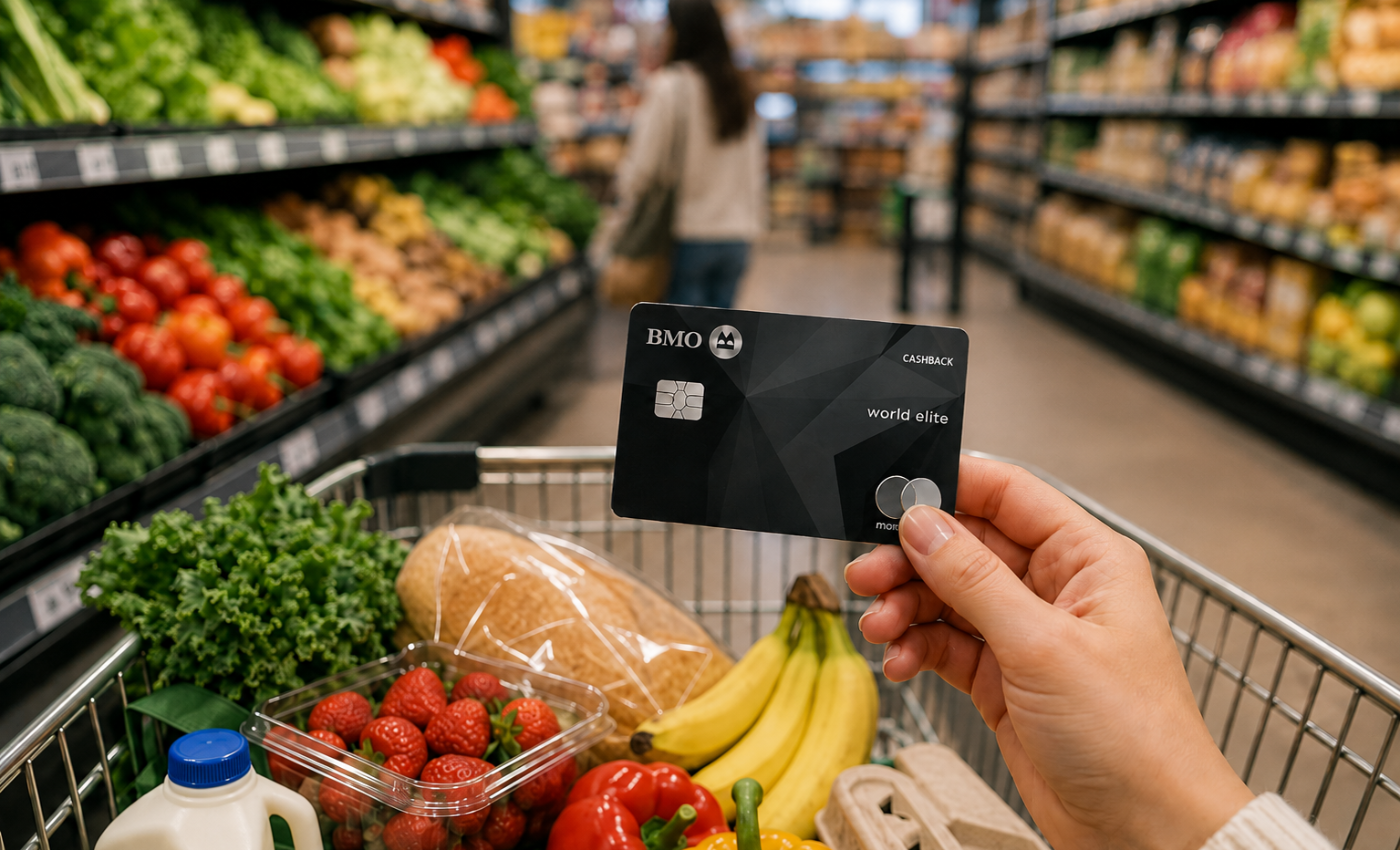
| BMO CashBack World Elite Mastercard | $139 (waived yr 1) | 5% cash back | $500/month |
| American Express Cobalt | $191.88/yr | 5 points/$1 (“eats & drinks”) | $2,500/month spend |
| CIBC Dividend Visa Infinite | $120 (waivable) | 4% cash back | $20,000/yr combined bonus categories |
| Tangerine Money-Back Mastercard | $0 | 2% (if chosen as a bonus category) | None published |
1. Scotiabank Gold American Express
This card earns up to 6 Scotia Rewards points per dollar at major Canadian grocery chains, with a $120 annual fee, no foreign transaction fee, and a minimum personal income of just $12,000/year — one of the most accessible premium grocery cards on the market. What this means for you: if groceries are your biggest recurring expense, this rate is hard to beat without an even higher annual fee.
2. BMO CashBack World Elite Mastercard
Earns a flat 5% cash back on groceries, capped at $500 in monthly grocery spending (about $6,000/year at the bonus rate). The card requires $80,000 personal or $150,000 household income and carries a $139 annual fee, waived in year one.
3. American Express Cobalt
Cobalt earns 5x Membership Rewards points on “eats and drinks” — which includes groceries, restaurants, bars, and food delivery — capped at $2,500 in monthly spending. It has no stated minimum income, but charges its $191.88 annual fee monthly ($15.99/month) rather than as a lump sum.
4. CIBC Dividend Visa Infinite
Earns 4% cash back on groceries and gas combined, up to a $20,000/year cap on that combined bonus spending. Requires $60,000 personal or $100,000 household income, with a $120 annual fee that can be waived with an eligible CIBC bank account.
5. Tangerine Money-Back Mastercard
A no-fee option: pick groceries as one of your 3 bonus categories and earn 2% back, with no published spending cap and no income requirement. It won’t out-earn the premium cards above, but there’s nothing to lose by carrying it.
How to Pick the Right Grocery Card for You
- Do the math on your actual grocery bill. A 5% card with a $500/month cap tops out around $300/year in rewards — compare that to the annual fee before assuming “higher rate” means “better card.”
- Check if your grocery store takes the card’s network. American Express has more limited acceptance than Visa or Mastercard at some independent and discount grocers.
- If you spend under $500/month on groceries, a no-fee card like Tangerine may earn you more net rewards than a premium card once the annual fee is factored in.
Frequently Asked Questions About Grocery Credit Cards
Do grocery rewards cards work at Costco? Only if the card is a Mastercard — Costco Canada accepts Mastercard and debit only in-store (Visa and Mastercard both work for online orders at Costco.ca).
Is a grocery card worth an annual fee? It depends on your grocery spending. As a rough rule, if you spend $2,000+/month on groceries, a premium card’s higher earn rate usually outweighs a $120–$140 annual fee — below that, a no-fee card is often the better deal.
Can I combine a grocery card with a loyalty program like PC Optimum? Yes — a credit card’s cash back or points are separate from store loyalty programs, so you can stack a card’s rewards with points from PC Optimum, Scene+, or a similar in-store program.
Key Takeaways
- Grocery-focused credit cards in Canada range from 2% (no-fee cards) up to 6% (premium cards with an annual fee).
- Almost every high-earning grocery card caps the bonus rate at a certain monthly or annual spending level — check the cap before assuming the advertised rate applies to your whole grocery bill.
- Costco Canada only accepts Mastercard and debit in-store, which rules out Visa and Amex grocery cards for in-person Costco runs.
- If your grocery spending is modest, a no-fee card can out-earn a premium card once the annual fee is subtracted.