
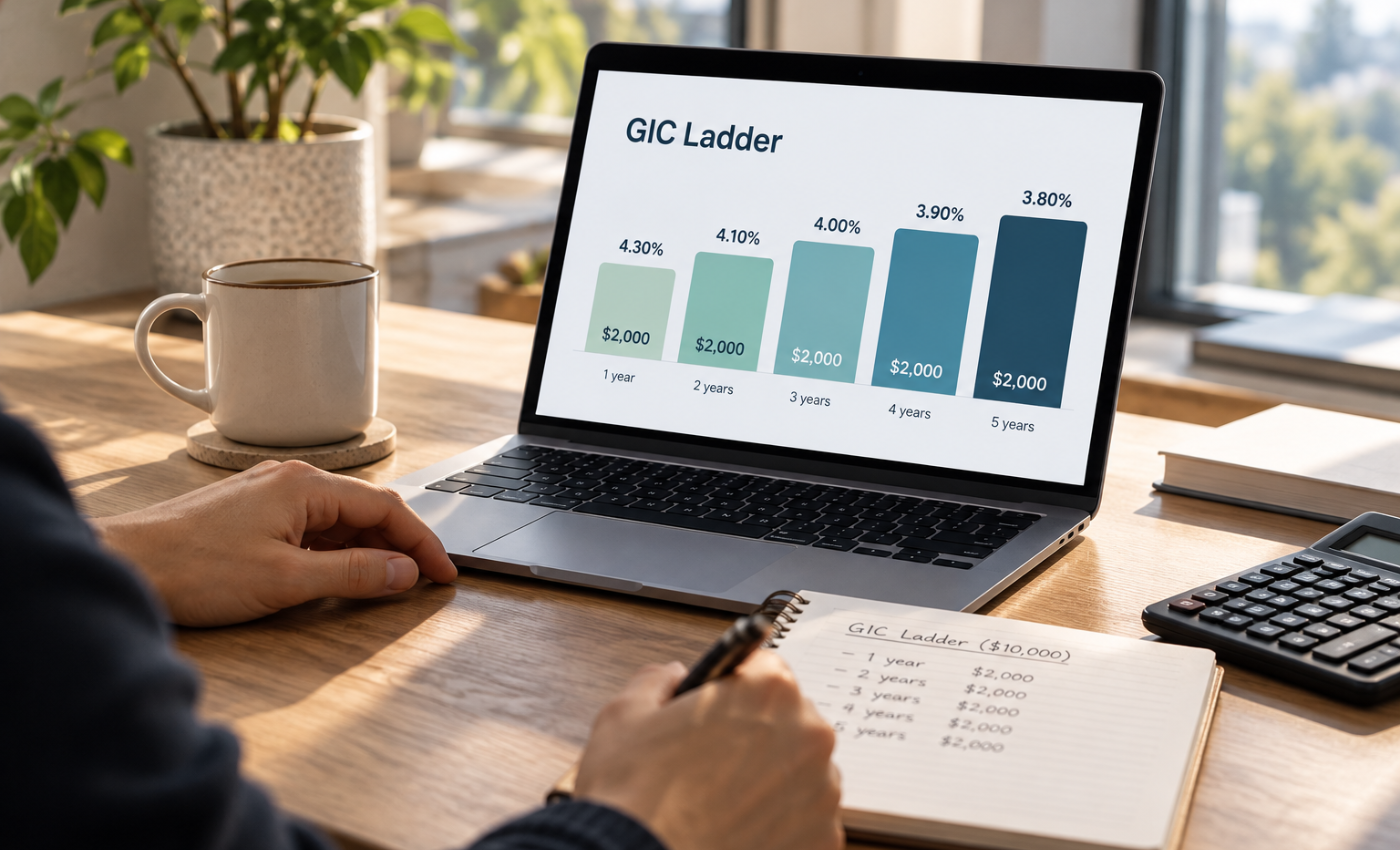
A GIC ladder splits your savings across several GICs with different terms, so part of your money comes due every year. Instead of locking $10,000 into one 5-year GIC, you put $2,000 each into a 1-, 2-, 3-, 4- and 5-year GIC. Every year one of them matures, and you either use that money or reinvest it in a new 5-year GIC at whatever the rate is then.
Using rates we checked on the banks’ own sites on October 12, 2026, a $10,000 ladder at Oaken Financial would earn about $424 in its first year, and the same ladder at RBC’s posted rates would earn about $260. This guide explains how the ladder works, what it earns today, where it falls short, and how to set one up.
Short answer: A GIC ladder splits your savings across GICs of different lengths, such as five $2,000 GICs of 1 to 5 years, so one matures every year. At rates checked on October 12, 2026, a $10,000 ladder would earn about $424 in its first year at Oaken, against about $260 at RBC’s posted rates. You get regular access to part of your money, but most of it stays locked in.Key points from this guide
What Is a GIC Ladder?
In simple terms: a GIC ladder is a way of buying GICs so that you get most of the higher rate of a long-term GIC without having all of your money locked up for years.
A GIC (Guaranteed Investment Certificate) pays a fixed interest rate for a set term, and a non-redeemable GIC cannot be cashed early. Longer terms usually pay more, which creates a trade-off: the best rate means the longest wait. A ladder handles that trade-off by spreading your money across terms, so each “rung” matures at a different time. If you’re new to GICs, our beginner’s guide to GICs covers the basics first.
How Does a GIC Ladder Work?
The most common version is a five-rung ladder built with equal amounts:
- Year 0: split your money into five equal parts and buy a 1-year, 2-year, 3-year, 4-year and 5-year GIC.
- Year 1: the 1-year GIC matures. If you don’t need the money, reinvest it in a new 5-year GIC.
- Years 2 to 4: repeat each time a rung matures, always buying a new 5-year GIC.
- From year 5 onward: every rung is now a 5-year GIC, but one of them still matures every year.
After the first four years, all of your money earns 5-year rates, which are usually the highest, yet you still get access to a fifth of it every year. That is the whole point of the ladder.
What Would a $10,000 GIC Ladder Earn Right Now?
Here is the same $10,000 ladder, $2,000 per rung, at three online institutions and at RBC’s posted rates. All rates are non-redeemable, non-registered, annual-pay rates, taken from each institution’s own website on October 12, 2026.
| Rung | Oaken | EQ Bank | Tangerine | RBC (posted) |
|---|---|---|---|---|
| 1-year GIC | 3.80% | 3.70% | 3.60% | 2.45% |
| 2-year GIC | 4.25% | 4.00% | 3.85% | 2.55% |
| 3-year GIC | 4.30% | 4.15% | 4.10% | 2.55% |
| 4-year GIC | 4.35% | 4.20% | 4.15% | 2.70% |
| 5-year GIC | 4.50% | 4.30% | 4.25% | 2.75% |
| Average rate | 4.24% | 4.07% | 3.99% | 2.60% |
| First-year interest on $10,000 | $424 | $407 | $399 | $260 |
A few things stand out:
- Where you build the ladder matters more than how you build it. The same structure earns about $164 more in its first year at Oaken than at RBC’s posted rates.
- Big banks’ posted rates aren’t their best rates. On the same page, RBC also advertises special non-redeemable rates of 3.00% for 1 year, 3.20% for 2 years and 3.55% for 5 years. If you bank with a Big Five bank, ask for its special rates before accepting the posted ones.
- The ladder costs you a little up front. Putting all $10,000 into Oaken’s 5-year GIC would earn $450 in year one, $26 more than the ladder, but none of that money would be available for five years.
If rates stayed exactly where they are today (they won’t, but it shows how the ladder settles), a fully rolled Oaken ladder would eventually earn 4.50% on the whole $10,000, about $450 a year, while still releasing $2,000 every year. Rates change often, so check the current figures in our weekly GIC rate table before you buy.
Why Not Just Buy One 5-Year GIC?
A ladder gives up a small amount of interest at the start in exchange for three things:
- Regular access to your money. Something matures every year, so a planned expense or a change of plans doesn’t force you to wait five years or pay to break a GIC.
- Less rate-timing risk. You don’t have to guess whether rates will rise or fall. If they rise, the rung that matures each year gets reinvested at the higher rate. If they fall, the rungs you already hold keep their higher rates for longer.
- Close to long-term rates over time. Once the ladder is fully rolled, all of it earns 5-year rates.
What Are the Downsides?
- Most of your money is still locked in. Only one rung is available each year. A ladder is not an emergency fund; money you might need on short notice belongs in a high-interest savings account. Our HISA vs GIC comparison goes through how to split the two.
- Reinvestment risk works both ways. If rates fall over the next few years, each maturing rung gets reinvested at a lower rate.
- Interest is taxable every year outside a registered account. In a non-registered account, interest on a GIC is taxed as it builds up, even when it’s only paid out at maturity. Your institution issues a T5 slip each year.
- It takes a little upkeep. You need to decide what to do with each rung when it matures. Some institutions renew a maturing GIC automatically for the same term, which quietly breaks the ladder if you meant to buy a 5-year GIC instead.
How Many Years Should You Spread It Over?
Five one-year rungs is the classic setup because it lines up with the 1- to 5-year terms most institutions offer, but it isn’t the only option:
- A shorter ladder (for example 1, 2 and 3 years) suits money you expect to need within a few years, such as a home down payment.
- A short-term ladder built from 3-, 6- and 9-month GICs works for money you need within a year, though short terms usually pay less. EQ Bank currently pays 2.55% for 3 months and 3.25% for 9 months.
- Going past five years rarely pays right now. EQ Bank’s 6-, 7- and 10-year GICs pay 2.35%, well below its 4.30% five-year rate. Longer is not automatically better, so compare before you lock in.
Where Should You Hold a GIC Ladder: TFSA, RRSP or Non-Registered?
Because GIC interest is fully taxable in a regular account, holding the ladder inside a registered account can make a real difference:
- TFSA: interest grows tax-free and withdrawals aren’t taxed, which suits a ladder you might draw on. See our TFSA guide for how contribution room works.
- RRSP: interest is sheltered until you withdraw, and withdrawals are taxed as income. This suits retirement money you won’t touch.
- FHSA: a good fit if the ladder is for a first home, since qualifying withdrawals are tax-free.
EQ Bank offers the same GIC rates in TFSAs, RRSPs and FHSAs as in its regular accounts; other institutions may price registered GICs differently. Which account is best depends on your income, your available room and when you’ll need the money, so if you’re unsure, it’s worth checking with a qualified tax professional or financial planner.
Is a GIC Ladder Safe?
GICs are among the safest places to keep savings in Canada. GICs at CDIC member institutions are covered by the Canada Deposit Insurance Corporation up to $100,000 per category, per institution, including principal and interest. The categories are separate: deposits in your own name, joint deposits, TFSAs, RRSPs, RRIFs, FHSAs, RESPs, RDSPs and deposits held in trust are each covered up to $100,000.
EQ Bank, Oaken and Tangerine GICs are all CDIC-covered, as are those at the Big Five banks. If your ladder is larger than $100,000 in a single category, you can spread the rungs across two or more institutions to stay within the limit. Credit unions are covered by provincial deposit insurance instead of CDIC, and the limits vary by province; our GIC rate table notes which insurer applies to each institution.
How Do You Build a GIC Ladder, Step by Step?
- Decide how much to ladder. Keep your emergency fund in a savings account first; the ladder is for money you won’t need all at once.
- Pick the length. Five years with five equal rungs is a sensible default.
- Choose the account type. TFSA, RRSP, FHSA or non-registered, based on what the money is for.
- Compare current rates for every term. Our GIC rate table is re-checked each week against the institutions’ own sites, and we have detailed pages for Oaken, EQ Bank and Tangerine. You don’t have to use one institution for every rung, but check each one’s minimum deposit (Oaken’s is $1,000; EQ Bank’s is $100).
- Buy the rungs. Choose non-redeemable GICs for the higher rates, and pick annual interest or interest at maturity (compounded), whichever suits you.
- Set reminders. Put each maturity date in your calendar, and check whether the institution will automatically renew a maturing GIC and for what term.
- Roll each maturing rung into a new 5-year GIC, unless you need the money or rates elsewhere look better.
Key Takeaways
- A GIC ladder spreads your money across GICs that mature in different years, so part of it becomes available every year while most of it earns longer-term rates.
- At rates checked October 12, 2026, a $10,000 five-rung ladder earns about $424 in its first year at Oaken, $407 at EQ Bank and $399 at Tangerine, versus $260 at RBC’s posted rates.
- Where you buy matters more than the ladder itself. Big banks often have special rates well above their posted ones, so ask.
- It isn’t an emergency fund. Keep short-notice money in a high-interest savings account.
- Consider a TFSA, RRSP or FHSA to avoid paying tax on the interest every year, and stay within CDIC’s $100,000-per-category limit at each institution.
Rates shown were taken from each institution’s website on October 12, 2026, for non-redeemable, non-registered GICs with annual interest, and can change at any time. The interest figures are simple first-year estimates for illustration. This article is general information, not personalized financial advice; your own situation, including your tax bracket and when you’ll need the money, may point to a different approach.