
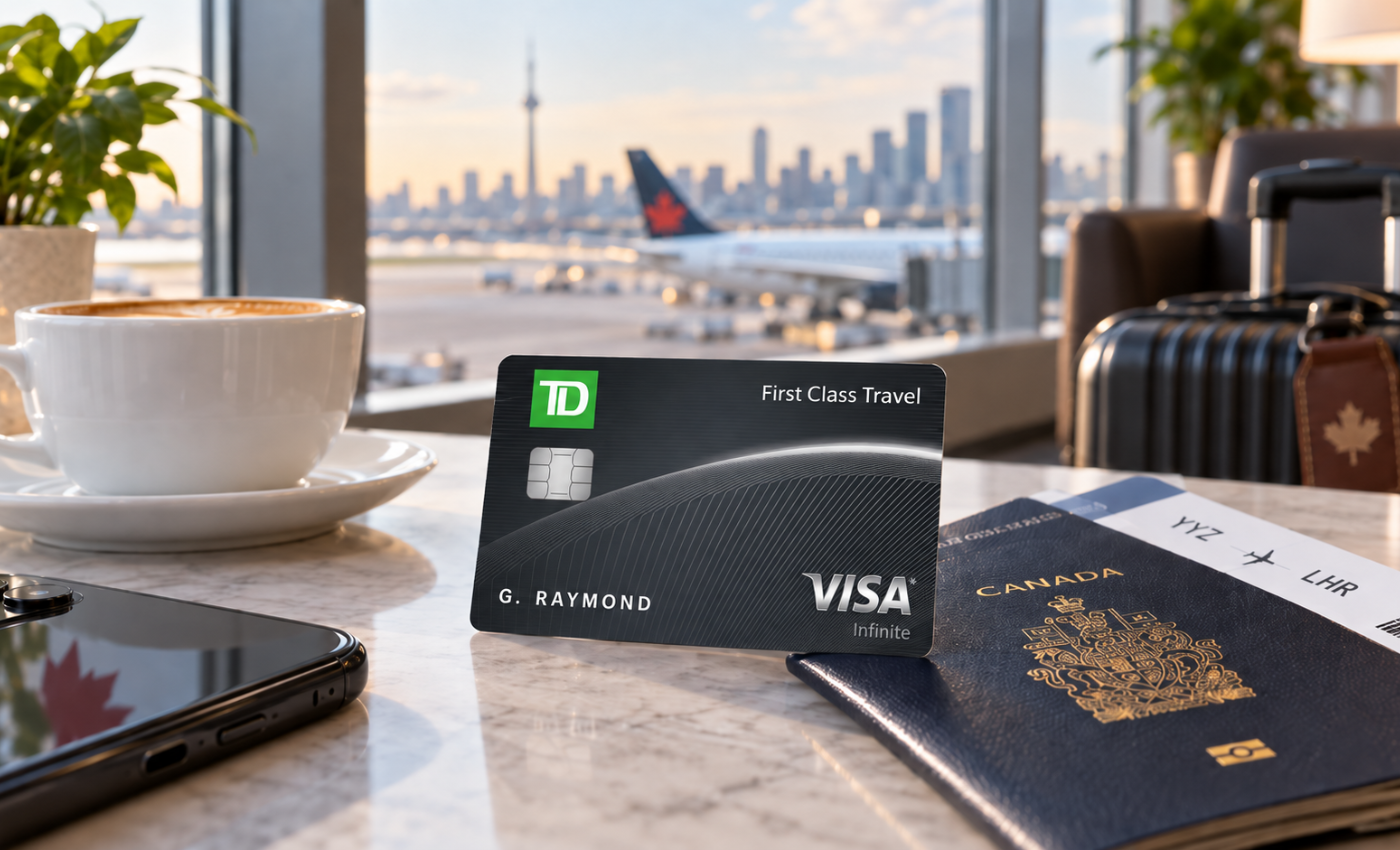
TD raised the welcome offer on the TD First Class Travel Visa Infinite Card on September 1, 2026, and the new number is the largest attached to any credit card in Canada right now: 160,000 TD Rewards points. Nothing else on the market comes close on raw point count.
A figure that big deserves a plain question rather than an exclamation mark. What is it worth in dollars? Roughly $800 of travel — or about $400, if you redeem it the way most people do. The gap between those two numbers comes down to a single decision you make months after the points land, and it is not the decision most people expect.
Short answer: For the right person, yes, but it is worth less than the number suggests. TD points are worth roughly half a cent, so 160,000 points come to about $800 booked through Expedia For TD, or $400 on everyday purchases. Redeemed well, first-year value is roughly $950. It suits you if you meet the $60,000 personal or $100,000 household income requirement and can spend $7,500 in 180 days.Key points from this guide
What the TD First Class Travel Bonus Actually Pays
The 160,000 points do not arrive together. A first purchase of any size releases 20,000 of them, which is the easy part. The remaining 140,000 points require $7,500 of spending within 180 days of opening the account, according to TD’s own offer terms. That split matters more than it looks, because almost 90% of the headline sits behind the threshold, and missing it does not scale the bonus down — it removes that portion entirely.
The card’s $139 annual fee is waived for the first year, covering both you and your first additional cardholder, provided the card is activated and used within three months. TD publishes no end date for the offer and reserves the right to change or withdraw it at any time, which is worth knowing if your instinct is to wait and think it over.
What Is a TD Rewards Point Worth?
Here is where the TD First Class Travel headline quietly parts company with reality. A TD Rewards point is worth roughly half a cent, where an Aeroplan point or a Scene+ point is generally worth about a full cent. Comparing 160,000 TD points against a 70,000-point offer somewhere else is not comparing like with like, and the gap is almost exactly the factor of two you would expect.
It gets more particular than that, because TD runs three different redemption rates and the spread between the best and the worst is enormous:
| How you redeem | Points per $1 | 160,000 points = |
|---|---|---|
| Booking travel through Expedia For TD | 200 | $800 |
| Paying off a travel purchase you already made | 225 | $711 |
| Paying off an everyday, non-travel purchase | 400 | $400 |
What this means for you: the same pile of points is worth $800 or $400 depending on nothing more than which button you press when you spend them. Booking a flight through Expedia For TD doubles what you get compared with quietly wiping a grocery bill off your statement. Redemptions there happen in 200-point increments with a 200-point minimum, so there is no reward for hoarding — only a real and avoidable cost to cashing out the wrong way.
What Is the TD First Class Travel Card Worth in Year One?
Redeemed properly, the first year of the TD First Class Travel card adds up to roughly $950. The welcome bonus supplies $800 of travel, the card’s annual $100 TD Travel Credit covers a chunk of a booking through Expedia For TD, and a birthday bonus of up to 10,000 points contributes about $50 more. Against a fee of nothing in year one, that is a genuinely strong opening, and it comes alongside four airport lounge visits through the Visa Airport Companion Program and a fairly complete travel insurance package.
It is worth keeping the comparison honest, though. A 70,000-point offer in a program where points are worth a full cent lands in the same neighbourhood, so the TD First Class Travel bonus is a strong contender rather than the runaway winner the raw number implies. Our roundup of current welcome bonuses sets the alternatives side by side.
Who Can Actually Qualify for the TD First Class Travel Card?
Two gates stand between the headline and your account, and both of them exclude a fair number of people who would otherwise apply on the strength of the number alone.
The first is income. This is a Visa Infinite card, which means TD requires $60,000 in personal income or $100,000 household. If you sit near or below that line the bonus is not available to you at any size, and your effort is better spent on cards built for that tier — we cover them in our guide to the best credit cards at a $60,000 income.
The second is the spending threshold, and it deserves an honest look rather than optimism. $7,500 across 180 days works out to $1,250 every month. For a household already routing groceries, gas, insurance and the occasional flight through a single card, that happens without trying. For someone who taps debit most days and reaches for credit occasionally, it does not, and the consequence is not a smaller bonus but the loss of 140,000 of the 160,000 points.
Try this before you apply: add up the last three months on whatever card you use now. If the monthly average sits comfortably above $1,250 you are fine. If it is borderline, decide which recurring bills you would move across first — that plan is worth making in advance, not in month five.
How the TD First Class Travel Card Earns
Multipliers are close to meaningless across different programs, so the useful move is to translate them into the percentage you are actually getting back. At 200 points per dollar of travel, the card’s 8 points per $1 on travel booked through Expedia For TD works out to about 4%. Groceries, dining and public transit earn 6 points per $1, or roughly 3%. Recurring bills and streaming earn 4 points, about 2%, and everything else earns 2 points, or about 1%.
In simple terms: 8x sounds overwhelming next to a card advertising 5x, but since a TD point is worth about half of a Scene+ or Membership Rewards point, that 8x behaves more like 4x would elsewhere. Converting to percentages before comparing cards across programs is the single habit that prevents most rewards-card mistakes.
What Happens in Year Two?
The fee waiver is a first-year benefit and the welcome bonus is a one-time event, so year two is when the card has to justify itself on its ongoing rates alone. Covering the $139 fee takes 27,800 points, which sounds abstract until you convert it into spending: about $4,600 a year, or $386 a month, if it lands in the 6-points-per-dollar categories, and around $13,900 if most of it sits in the 2-points bucket.
The $100 travel credit closes much of that gap, but only for people who genuinely book through Expedia For TD. If you prefer booking direct with airlines and hotels — for the status, the flexibility, or simply the easier customer service when something goes wrong — then the credit and the 8x category both quietly stop applying, and the card’s case weakens considerably.
Is the TD First Class Travel Card Worth It?
It makes sense if you clear the income requirement, already put more than $1,250 a month on a card, and are comfortable booking travel through Expedia For TD. Those three conditions together turn the offer into about $950 of value against a $0 fee in year one, which is difficult to argue with on any reasonable reading.
It does not make sense if you book travel direct, redeem points against everyday purchases, or would be stretching to reach $7,500. Any one of those three roughly halves what the offer delivers, and two of them together leave you holding a $139 annual fee for a card earning about 1% on most of what you buy.
If the appeal is a straightforward rewards card rather than a travel-booking system, points worth a predictable full cent may suit you better — our comparison of the Amex Cobalt and Scotiabank Gold looks at two cards that redeem without conditions attached.
Key Takeaways
- The TD First Class Travel Visa Infinite is offering up to 160,000 TD Rewards points — 20,000 after the first purchase, and 140,000 for $7,500 spent within 180 days.
- TD Rewards points are worth about half a cent, making 160,000 points roughly $800 of travel booked through Expedia For TD rather than the four figures the number suggests.
- Redeem the same points against everyday purchases and they are worth $400 — the redemption method matters as much as the bonus size.
- First-year value lands near $950 once the $100 travel credit and birthday points are counted, with the $139 fee waived.
- You need $60,000 personal or $100,000 household income, plus $1,250 a month of spending to clear the threshold.
- From year two, covering the fee alone takes about 27,800 points — roughly $386 a month on groceries, dining and transit.
This article is for general educational purposes and isn’t financial advice. Welcome offers, earn rates, redemption values and fees are set by the issuer and change frequently — confirm current terms with TD before applying. Figures were checked in September 2026.