
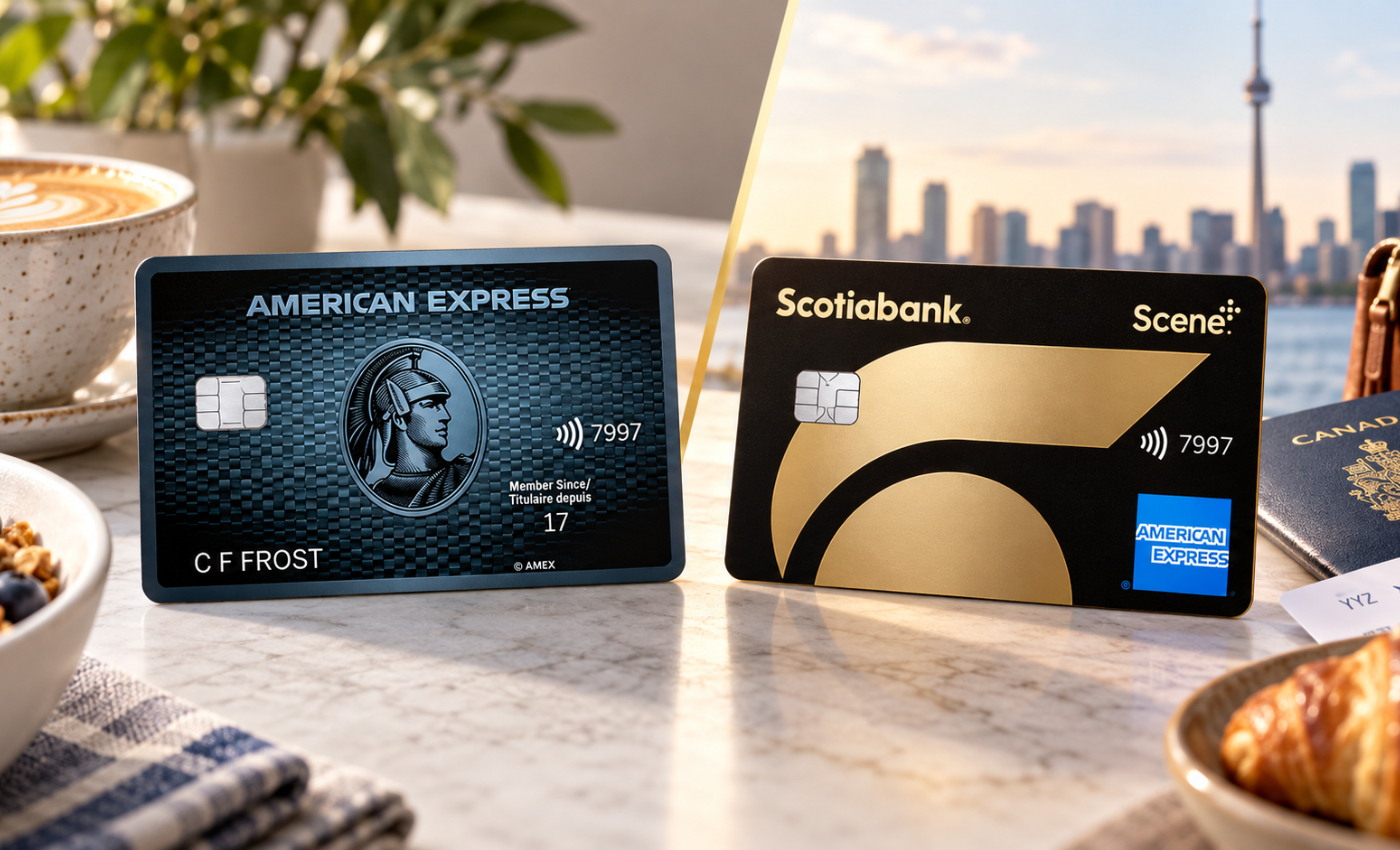
Two Canadian cards dominate every “best card for food” list, and they are both American Express. Put Cobalt vs Scotiabank Gold side by side and the surprise is how one-sided the paper comparison looks — the cheaper card also earns more in most categories.
That is not the whole story. In Cobalt vs Scotiabank Gold there is one number that flips the result, and it has nothing to do with earn rates.
Short answer: On paper the Scotiabank Gold American Express wins: it costs $120 a year against the Cobalt’s $191.88, matches or beats it in every earn category, and comes out roughly $90 to $160 a year ahead on typical household spending at one cent per point. The Cobalt only pulls ahead if you redeem Membership Rewards through Fixed Points Travel or airline transfers at about 1.13 to 1.24 cents per point, and the Scotiabank Gold also charges no foreign transaction fee.Key points from this guide · last reviewed Sep 14, 2026
Cobalt vs Scotiabank Gold: What You Actually Pay
The first thing to settle in Cobalt vs Scotiabank Gold is the price of admission, because the two fees are structured differently and are easy to misjudge.
The American Express Cobalt bills $15.99 a month. That feels small. Over a year it is $191.88.
The Scotiabank Gold American Express charges $120 a year, billed once, plus $29 for each additional card.
In simple terms: the Cobalt costs about $72 more per year. Before you earn a single point, it starts behind.
Neither card is hard to qualify for on income. Scotiabank asks for a minimum personal income of $12,000 a year; Amex publishes no income minimum for the Cobalt. Both run at a 21.99% purchase interest rate, so both are expensive to carry a balance on — rewards cards almost always are.
Where the Points Come From
This is where most comparisons stop, so it is worth reading the rows carefully.
| You spend on | Amex Cobalt | Scotiabank Gold |
|---|---|---|
| Groceries at Sobeys, Safeway, FreshCo, Foodland | 5x | 6x |
| Groceries anywhere else | 5x | 5x |
| Restaurants, bars, food delivery | 5x | 5x |
| Movies, theatre, event tickets | 1x | 5x |
| Gas and transit | 2x | 3x |
| Streaming | 3x | 3x |
| Everything else | 1x | 1x |
| Where the bonus rates stop | $2,500 of food spending per month | $50,000 of total spending per year |
| Foreign transaction fee | 2.5% | None |
Read down the Scotiabank column and there is no category where the Cobalt earns more. It ties on restaurants, ties on streaming, ties on non-Sobeys groceries, and loses everywhere else.
The two caps work differently too, and that matters later. The Cobalt caps only its top category, at $2,500 of food spending per billing period — roughly $30,000 a year on groceries and restaurants alone, which most households never reach. The Scotiabank Gold caps everything at $50,000 of total purchases per calendar year, after which every dollar earns 1x.
So Who Earns More on Normal Spending?
Take a household that puts a realistic amount of everyday life on one card each month:
- $600 groceries
- $250 restaurants and food delivery
- $150 gas
- $40 streaming
- $1,000 on everything else
That is $2,040 a month, or about $24,480 a year — comfortably under the Scotiabank cap.
Both programs value a point at roughly one cent for straightforward redemptions. Scene+ takes 100 points per dollar of travel and 1,000 points for $10 of groceries. Membership Rewards gives $10 in statement credits per 1,000 points. At that value, over a year:
Amex Cobalt: about 68,000 points, worth roughly $680. Minus the $192 fee, you keep about $489.
Scotiabank Gold, Sobeys shopper: about 77,000 points, worth roughly $770. Minus the $120 fee, you keep about $650.
Scotiabank Gold, shops at Loblaws or Metro: about 70,000 points, worth roughly $698, leaving about $578.
What this means for you: on identical spending, the Scotiabank Gold comes out $90 to $160 ahead — and that is before counting its entertainment category, which the Cobalt does not have at all.
The Number That Settles Cobalt vs Scotiabank Gold
Everything above assumes a point is a point. It isn’t.
Scene+ is close to fixed. A point is worth about a cent whether you put it toward travel, groceries at a Sobeys-family store, or a statement credit. Simple, predictable, hard to get wrong.
Membership Rewards moves. The same point can be worth:
- 0.7 cents spent at Amazon.ca or through PayPal
- 1 cent as a statement credit or travel credit
- Up to 1.5 cents through Fixed Points Travel, where 20,000 points covers a return economy flight in Canada or the U.S. with a base fare up to $300
- Potentially more transferred to Aeroplan or another airline partner — if you actually use transfers well
So the real question in Cobalt vs Scotiabank Gold is not which card earns more points. It is how much each of your points is worth when you spend it.
Run the break-even on the household above and the Cobalt needs its points to be worth about 1.24 cents to catch a Sobeys shopper on the Scotiabank Gold, or about 1.13 cents to catch everyone else.
Quick tip: be honest about how you redeem. If your points have historically turned into statement credits or Amazon purchases, you are getting 0.7 to 1 cent, and the Cobalt cannot win. Only book-a-flight redeemers clear 1.24 cents reliably.
What Happens When You Spend Outside Canada?
This gap is larger than the earn rates and gets overlooked.
The Scotiabank Gold charges no foreign transaction fee — unusual in Canada, where 2.5% is standard. On $3,000 of foreign-currency spending, that is $75 you simply don’t pay.
The Cobalt charges the usual 2.5%. Worse, since October 2024 its bonus multipliers apply only to purchases in Canadian dollars. A restaurant meal in Paris earns 1x on the Cobalt, not 5x — and costs 2.5% extra.
What this means for you: if you travel even occasionally, this alone can decide it. Our roundup of no-foreign-transaction-fee cards covers the other options.
When Does the Cobalt Still Win?
There are three situations where Cobalt vs Scotiabank Gold goes the other way, and they are real:
1. You spend more than $50,000 a year on the card. Past that, the Scotiabank Gold drops to 1x on everything for the rest of the calendar year. The Cobalt keeps 5x on food up to $2,500 a month, plus uncapped 3x and 2x categories.
2. You genuinely transfer points to airlines. Not “I might one day.” If you already redeem Aeroplan seats and understand what a good redemption looks like, Membership Rewards has headroom that Scene+ does not.
3. You can’t get the Scotiabank welcome offer. Its current bonus — 30,000 points for $2,000 in the first three months, plus 20,000 more for $7,500 in the first year — is open to accounts opened between July 2 and November 1, 2026, and excludes anyone who has held a Scotiabank personal credit card in the past two years. The Cobalt’s offer pays 1,250 points per billing period, up to 15,000 in year one, but requires $750 of spending every single month to collect in full.
Cobalt vs Scotiabank Gold: Picking One
Choose the Scotiabank Gold if you want the better result without managing it: lower fee, higher earn rates on most of what you buy, no foreign transaction fee, and points that are worth the same no matter how you cash them in. It is the stronger default for most people, and especially strong if you shop at Sobeys, Safeway, FreshCo or Foodland. Our full Scotiabank Gold review goes deeper on the perks.
Choose the Cobalt if you are a committed points person who books flights with transfers, or your spending runs past the $50,000 cap. Our review of whether the Cobalt is worth it works through its fee in more detail.
One caveat that applies to both: they are American Express cards, and Amex is accepted at fewer Canadian merchants than Visa or Mastercard. Most people carry a no-fee backup for the places that decline it. If groceries are the main event for you, our grocery card roundup compares these two against the cashback alternatives.
Key Takeaways
- The Scotiabank Gold costs $120 a year; the Cobalt’s $15.99 monthly fee works out to $191.88 — about $72 more.
- On earn rates the Scotiabank Gold matches or beats the Cobalt in every category, including 6x at Sobeys-family grocers and 5x on entertainment, where the Cobalt earns 1x.
- On realistic household spending the Scotiabank Gold comes out roughly $90 to $160 ahead per year at one cent per point.
- The Cobalt only wins if its Membership Rewards points are worth about 1.13 to 1.24 cents each — achievable through Fixed Points Travel or airline transfers, not through statement credits.
- The Scotiabank Gold charges no foreign transaction fee; the Cobalt charges 2.5% and has paid only 1x on foreign-currency purchases since October 2024.
- The Cobalt’s advantage returns above $50,000 of annual spending, where the Scotiabank Gold’s bonus rates stop entirely.
This article is for general educational purposes and isn’t financial advice. Card fees, earn rates, caps, welcome offers and points valuations are set by the issuers and change often — confirm current terms with American Express and Scotiabank before applying. Figures in this article were checked in September 2026.